
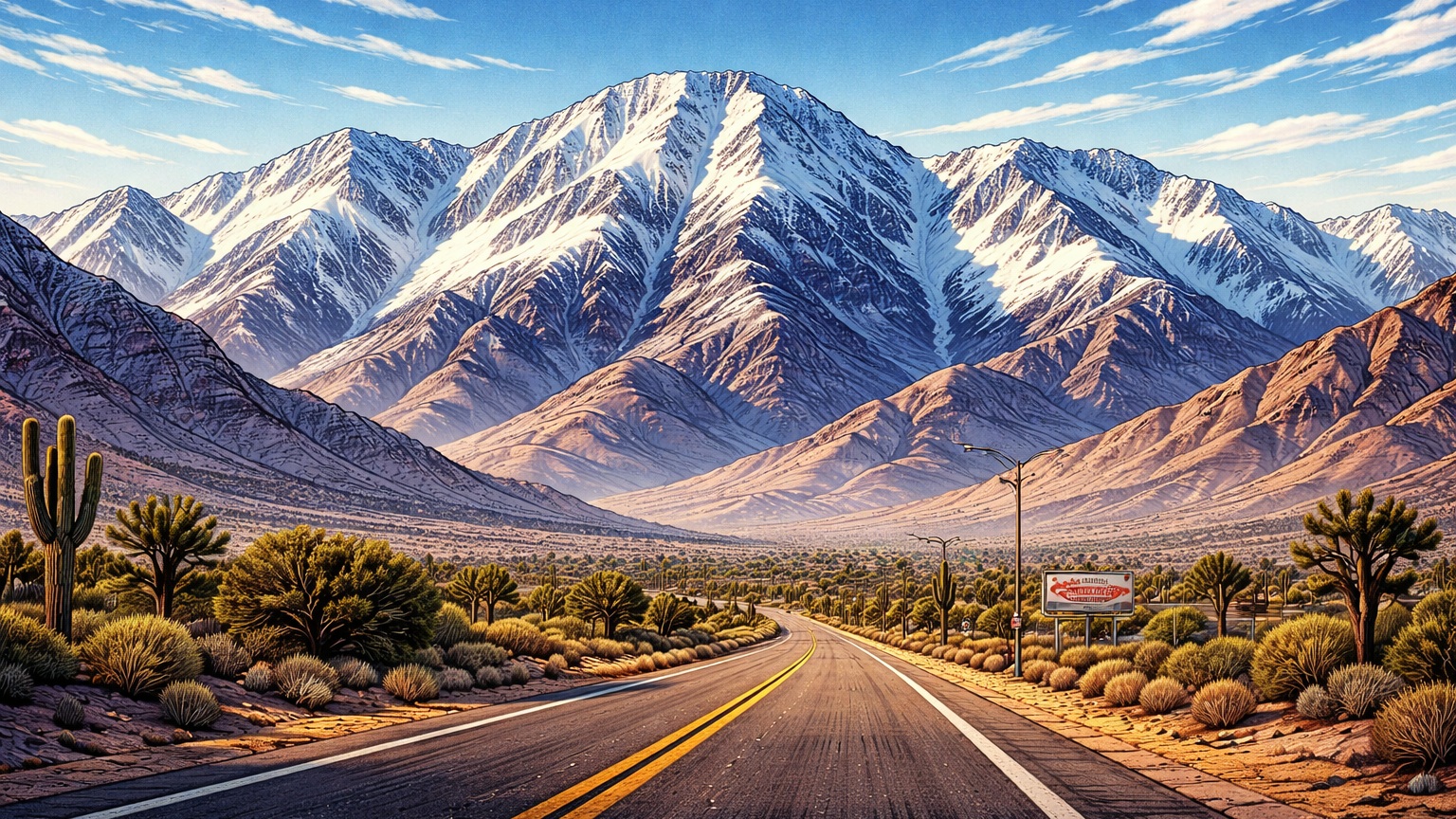
While I was driving to work on the freeway this morning, I noticed a phenomenon that I’ve only seen once before.
And it’s kind of spooky in a way. Surreal.
So I live in Las Vegas, which of course includes a lot more than just the world-famous Las Vegas Strip.
Locals refer to the whole Las Vegas Valley as “Vegas” — not just the Las Vegas city limits itself. It also includes North Las Vegas, Henderson, and unincorporated areas of the county.
Anyway, the whole valley is surrounded by mountains. And I’ve seen them a million times.
You’ve got Red Rock mountains to the northwest, Spring Mountains to the southwest, Black Mountain and the McCullough Range to the southeast, and more hills and mountains all around the perimeter.
But today, the mountains directly in front of me as I drove west along the freeway were… HUGE! I mean, way bigger than they usually look.
They were covered with snow, and the summits were free of any clouds. Just snowy mountain peaks against the stark blue of the sky.
I felt like I was in The Matrix or The Thirteenth Floor discovering that the world around me was all just a computer simulation, and somebody happened to miscode the mountains today.
Like, I actually questioned reality for a minute or two.
How could it possibly be real?
But after puzzling over it a bit, I figured there might be a logical explanation beyond “you’re living in the Writerverse.” LOL
And apparently this is a phenomenon based on a few scientific principles.
Snow reflection, contrast, atmospheric and terrestrial refraction.
Snow reflection and contrast: Fresh snow reflects much more sunlight than bare rock or trees. This makes the mountains stand out against the sky, highlighting their sharp, jagged features and creating the appearance of greater, more defined scale.
Atmospheric and terrestrial refraction: When the air is cold, it becomes denser, acting like a lens that bends light. This can reveal parts of the lower mountain that usually get hidden by the horizon, making them appear closer and larger.
Without getting bogged down in a science lesson, that’s enough to understand the gist of what’s happening.
But the most important piece for us writers is the contrast.
On the same drive, I heard a song called “Let Her Go” by Passenger. This isn’t a band I’m necessarily that familiar with — and Passenger is now the name of the singer, not just the former band.
But this guy (Michael David Rosenberg) has released 14 albums, which is pretty amazing.
Anyway, the first part of the chorus goes…
Well, you only need the light when it’s burning low,
Only miss the sun when it starts to snow,
Only know you love her when you let her go.
In other words, you can’t know good without bad, positive without negative. You can’t see white type on a white page. It’s the contrast that reveals what’s been there all along.
That’s why good storytelling needs that conflict in the middle before the happy ending — the part in a movie where you’re gripping your chair, leaning forward to get a better look… or hiding your eyes so you don’t have to look.
Situation > Complication > Resolution.
Like the PAS copywriting framework…
Problem > Agitation > Solution.
It’s OK to reveal the struggle and the pain. That’s the only way we know the solution works and the resolution is a happy ending.
This is especially important for Empaths, who typically like to smooth over the painful parts (AI does this too, by the way — so keep that in mind if you’re using AI to help with your writing process).
Rebels, on the other hand, tend to dwell too long in the conflict. Mechanics often don’t even think about it.
If you want to understand where you naturally avoid conflict — and where you lean into it — that’s exactly what your Writing Personality Type Toolkit reveals.

Write on,
Heather Vale
Helping you UnVALE your superpowers and navigate the Writerverse
The Writerverse is a safe place and I will protect your details in accordance with my Privacy Policy.